|
|
Instructions Search for sequences of words, universal/PTB POS tags and relation labels. Examples
ESL filters and highliting Filter query results to sentences with a specific grammatical error and/or specific native language. Corpus (UD v2.18)
Corpus (UD v2.3)
|
The Treebank of Learner English (TLE) is a collection of 5,124 English as a Second Language (ESL) sentences (97,681 words), manually annotated with POS tags and dependency trees in the Universal Dependencies formalism. The dataset represents upper-intermediate level adult English learners from 10 native language backgrounds, with over 500 sentences for each native language. The sentences were drawn from the Cambridge Learner Corpus First Certificate in English (FCE) corpus.
The dataset and the annotation guidelines were developed in a collaborative project between MIT CSAIL, MIT Linguistics and CBMM. Detailed information about the annotations is available in this paper. A draft of the manual used by the annotators is available here. Please contact Rivkah Bazlov (r_udp at bazlov dot uk) or Yevgeni Berzak (berzak at technion dot ac dot il) if you spot any errors or inconsistencies in the treebank, or if you have questions about the ESL annotation guidelines.
News
26/08/2026 The treebank has been updated to UD v2.18 guidelines! See changelog for more info.
11/15/2018 The treebank now conforms to UD v2 guidelines!
Citation
You are encouraged to cite the following papers when using the dataset:
- Yevgeni Berzak, Jessica Kenney, Carolyn Spadine, Jing Xian Wang, Lucia Lam, Keiko Sophie Mori, Sebastian Garza and Boris Katz (2016) "Universal Dependencies for Learner English", Annual Meeting of the Association for Computational Linguistics (ACL). [PDF] [bib]
- Helen Yannakoudakis, Ted Briscoe and Ben Medlock (2011) "A New Dataset and Method for Automatically Grading ESOL Texts", Annual Meeting of the Association for Computational Linguistics (ACL), pages 180-189.
Download
The TLE is available publicly through the UD repository (English-ESL).
People
Annotation and guidelines: Yevgeni Berzak, Jessica Kenney, Carolyn Spadine, Jing Xian Wang, Lucia Lam, Keiko Sophie Mori, Sebastian Garza, Boris Katz, Margarita Misirpashayeva, Rivkah Bazlov.
Web search: Emily Kellison-Lynn, Yevgeni Berzak, Andrei Barbu, Jessica Kenney.
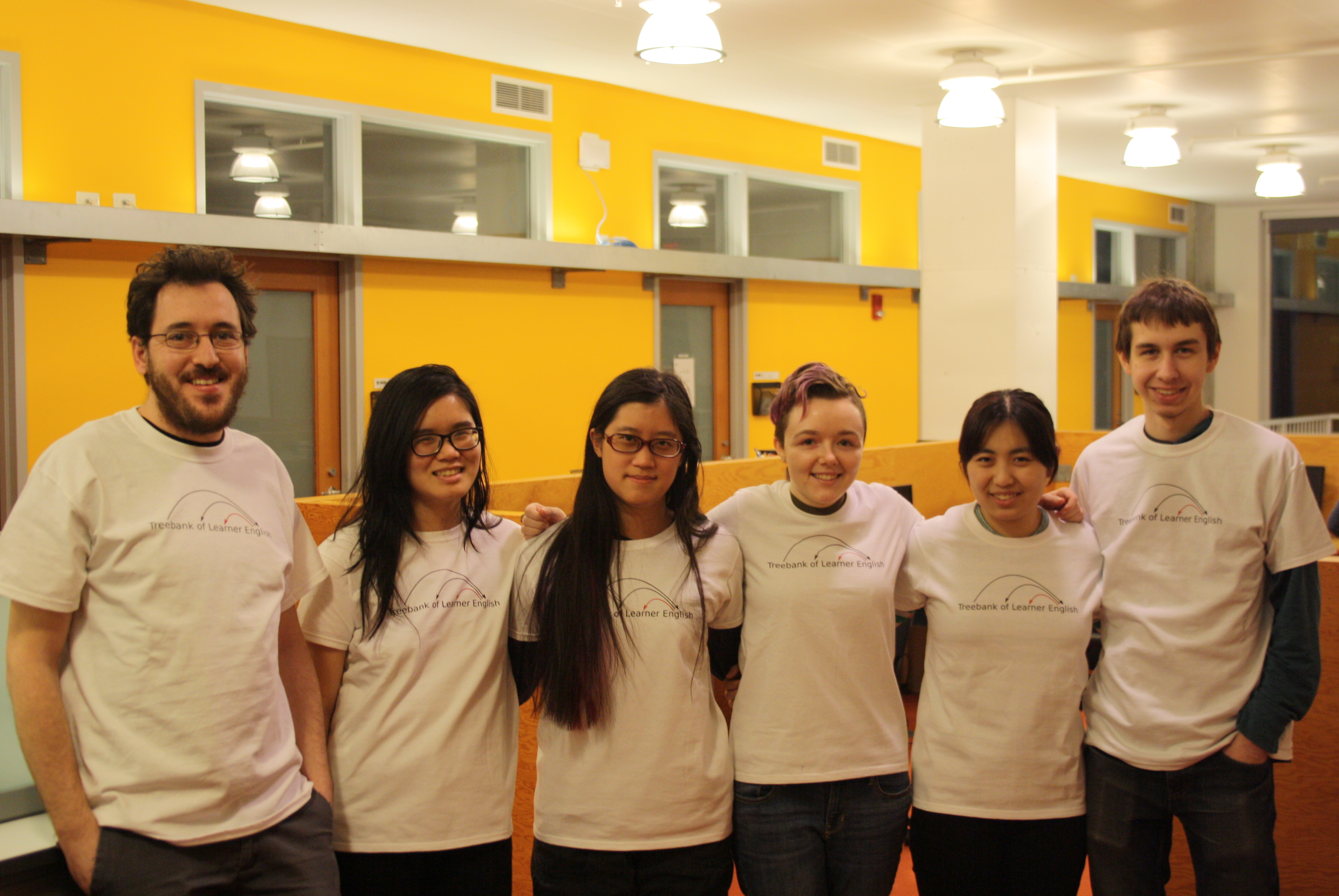
Team Annotations: Yevgeni, Lucia, Sophie, Jessica, Jing, Sebastian.





Changelog
2026-08-26: Update to UD v2.18
The UD English-ESL treebank was revised to bring the annotation into compliance with the current UD v2.18 validation requirements. Corrections were based on the original manually annotated treebank and the original MIT ESL annotation guidelines wherever possible.
SYNTAX changes
Dependency structure corrections
- Manually reviewed and corrected dependency structures reported as invalid by the UD validator.
- Corrected
leaf-detconfigurations in which a token attached with thedetrelation incorrectly governed a dependent that is not permitted under a determiner. Such dependents were reattached or the surrounding structure was reanalysed according to the original manual annotation. - Corrected
obl-should-be-nmodconfigurations. Dependents annotated asoblunder non-predicative nominal heads were changed tonmod, following the UD distinction between oblique dependents of predicates and nominal modifiers. - Other erroneous attachment structures were manually checked against the original annotation and corrected rather than modified automatically.
UPOS–dependency relation compatibility
- Reviewed all validator errors in which a dependency relation was incompatible with the dependent token's UPOS.
- Corrected incompatible
detannotations so that the relation and the POS analysis agree. - Corrected incompatible
caseannotations, including cases where tokens with nominal, adjectival, or determiner POS tags had incorrectly been assigned thecaserelation. - Corrected incompatible
advmod,aux,mark,cc, and related relation/POS combinations where present. - Corrected mismatches between
PUNCTand thepunctrelation. - Each mismatch was resolved using the original manual annotation and sentence context rather than by blindly replacing either the UPOS tag or dependency relation.
These changes address the validator's rel-upos-* family of checks.
Multiple subjects and objects in learner constructions
- Manually reviewed predicates annotated with more than one ordinary
nsubj/csubj, which trigger thetoo-many-subjectsvalidation check. - Manually reviewed predicates annotated with more than one
obj, which trigger thetoo-many-objectsvalidation check. - Where the original structure reflects an ESL production in which an additional constituent can be interpreted as a subject or object, the dependency tree was reanalysed into a UD-valid structure.
- The original learner-oriented interpretation was retained in MISC using:
Note=parses_as_nsubjNote=parses_as_obj
The MISC notes document the alternative interpretation of the learner construction; they are not used as substitutes for a valid basic dependency structure.
Punctuation
- Reviewed punctuation attachments throughout the treebank against the original MIT annotation guidelines and current UD punctuation constraints.
- Corrected punctuation attachments that introduced non-projectivity or in which the punctuation token itself was attached non-projectively.
- Corrected cases in which the
punctrelation and the token's UPOS disagreed. - Preserved the original intended punctuation structure whenever it was compatible with current UD requirements.
These changes address, where applicable, the punct-causes-nonproj, punct-is-nonproj, rel-upos-punct, and upos-rel-punct validation checks.
MORPHO changes
goeswith structures
- Reannotated tokenized typographical errors and accidentally separated word parts according to current UD
goeswithguidelines. - The first component of each interrupted word is treated as the head of the
goeswithstructure and retains the word's lexical and morphological annotation. - Subsequent components are attached to the first component with
goeswith. - Non-initial
goeswithcomponents were changed toUPOS=X. - Morphological features were removed from non-initial
goeswithcomponents so that the word-level morphology is represented only on the first component. goeswithgroups were checked to ensure that all components are contiguous, genuinely separated by whitespace, and attached in the correct left-to-right direction.
These changes address the validator's goeswith-upos, goeswith-feats, goeswith-lemma, goeswith-gap, goeswith-nospace, and related goeswith checks.
Typographical errors
- Added
Typo=Yesto the FEATS of heads ofgoeswithstructures, as required by current UD validation when morphological features are present. - Added
Typo=Yesto applicable typographical errors identified in the original learner annotation. - Automatically converted identifiable typo annotations from the source representation, followed by manual verification.
This specifically resolves the goeswith-missing-typo validation condition for split-word errors.
FEATS changes
- Populated the previously sparse FEATS column using morphological information converted from the original manually annotated source.
- Added UD morphological features to tokens for which corresponding morphological information is available in the source annotation.
- Added required
PronTypevalues to pronouns and determiners where applicable, avoidingpron-det-without-prontypevalidation warnings once the treebank contains morphological features. - Preserved and integrated existing features such as
Foreign=YesandPolarity=Neg. - Ensured that FEATS are attached to the appropriate component of
goeswithstructures rather than duplicated across split word parts. - Automatically converted feature values were manually checked for consistency with their UPOS tags and sentence context.
MISC changes
- Populated MISC with information needed to preserve analyses of learner-specific constructions that cannot be represented directly by the validator-compliant basic dependency tree.
- Added
Note=parses_as_objwhere an ESL construction contains a constituent that can naturally be interpreted as an additional direct object but cannot remain as a secondobjunder the same predicate. - Added
Note=parses_as_nsubjwhere an ESL construction contains a constituent that can naturally be interpreted as an additional subject but cannot remain as a second ordinarynsubjunder the same predicate. - These annotations preserve information about the original learner construction without deliberately retaining dependency structures rejected by current UD validation.